 TroutWindow
Aquatic insects
Bugs, stages, and what “hatch” really means
On the water, a “hatch” is the whole vulnerable window — not only the winged adult. We call out stage so you know whether to fish nymph, pupa, emerger, dun, or spinner.
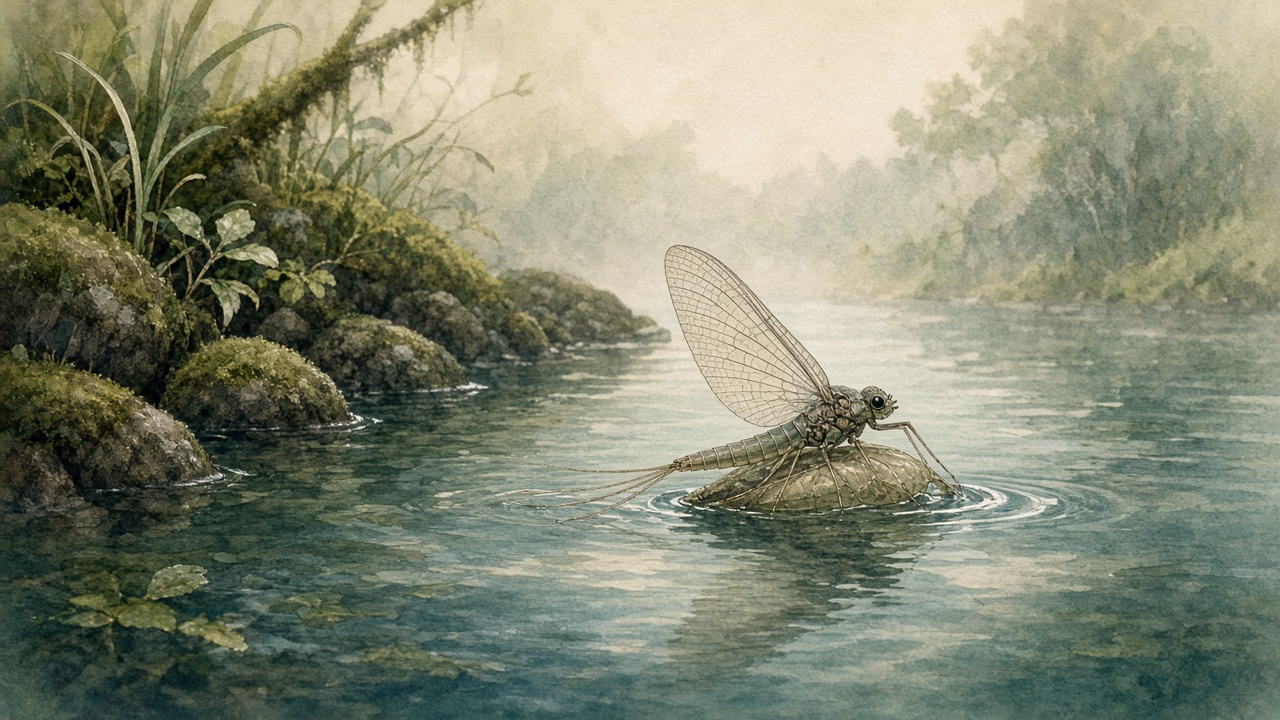
Two meanings of hatch
- Entomologist: the winged adult leaves the water.
- Angler: a concentrated meal — emergers, duns, spinner falls, plus the drift that builds before it.
How we label it: pre-hatch drift → emergence → adult/dun → spinner / egg-laying.
Orders that matter on SE trout water
Mayflies (Ephemeroptera)
Incomplete metamorphosis, plus the odd subimago. Egg → nymph (many molts) → subimago (dun) → imago (spinner). No pupa. Nymphs cling, crawl, swim (Baetis), or burrow (Hexagenia). Adults last hours to a few days. Spinner falls can outfish the dun hatch. SE priors: BWO, Quill Gordon, Hendrickson, March Brown, Sulphurs, Light Cahill, Tricos.
Caddisflies (Trichoptera)
Complete metamorphosis. Egg → larva → pupa → adult. Pupae often drift to the film — trout smash them before dries work. Angler stages: larva, pupa (critical), adult. SE: Black/Mottled Caddis, Grannom → Hydropsyche, Green Sedge, October Caddis.
Stoneflies (Plecoptera)
Incomplete metamorphosis. Egg → nymph → adult (usually crawl to the bank; no midstream emerger). Many live 1–3 years. Angler stages: nymph year-round, adult near banks. SE freestone summer signature: Yellow Sally / Golden Stones; also Early Black Stones, Giant Stones. (Salmonfly / Hex windows in the research notes are Rockies/Midwest signatures — left out of SE calendar priors.)
Midges (Chironomidae)
Complete metamorphosis. Egg → larva → pupa → adult. Year-round; winter and tailwater critical. Often many generations a year. Pupa in the film is the money stage.
Terrestrials
A separate bank-food layer, not a hatch-stage prediction. Summer SE signature alongside Yellow Sallies.
What drives growth and emergence
Water temperature / degree-days is the master variable (strong evidence). Also: food, day length (species-specific), dissolved oxygen and flow habitat, diapause (especially stoneflies).
Harper & Peckarsky 2006 (Ecological Applications): warming advanced Baetis emergence; cutting flow alone didn’t. Don’t treat discharge as an emergence button — use it for fishability and context.
Evidence vs folklore
- Water temperature (absolute windows + recent warming)
- Day length / photoperiod
- Time-of-day priors by species
- Cloud cover for some mayflies (BWOs on overcast/drizzle)
- Hydrograph phase as fishability context
- Barometric pressure as a direct hatch trigger
- Calendar date alone
Watch bands (heuristics, not laws)
- Midges ≳40 °F
- BWO ~46–56 °F
- Caddis ~55–56 °F
- PMD-class ~60 °F
These lean Rockies in the research notes; we use them as watch-fors on SE cards. Prefer local confirmation (thermometer, seine, eyeballs) over any app score.
Southeast notes
From the starter pack and insect brief: hot summers; Yellow Sallies + terrestrials are the summer signature; Tricos matter on spring/tailwater flats; timing runs earlier/lower-elevation than the Rockies; more summer heat constraint than the Northeast. Tailwaters can run ~3–4 weeks ahead in spring; water above 3500 ft ~2–4 weeks behind. Local shop calendars matter — founder check vs NCWRC hatch chart PDF and VA DWR pages still required.
Source: Aquatic Insect / Hatch Research Brief (2026-09-12). Key citations therein: Harper & Peckarsky 2006; Wright & Mattice Hexagenia degree-days; USGS BioData / stream temperature guides; practitioner windows from Cutthroat Anglers / Due West Anglers (decision aids, not biological constants). SE month lists also from NC VA Regional Starter Pack §3.